Settling and deciding with 定
The kanji 定 means decide or fix . In compounds, it can also describe something stable .
Etymology
This kanji isa phono-semantic compound comprised of 宀 (roof) as the semantic component and 正 as the phonetic component (テイ).
Visualize placing things under a roof and arranging them in orderly fashion, settling everything into its proper place. Just as objects set under a roof in proper order stay put, a decision or fixed arrangement remains in place.
Judgments
決定 (Decision)決定( けってい ) means a decision or determination. It refers to something being firmly settled.
It combines 決 (decide ) with 定 (fix ) to show a matter fixed by decision .
ご注文はうさぎですか? »
Volume 1 » Page 40
Cocoa shows off the bread she made.
ココア:
「じゃーんティッピーパン作( つく ) ってみたんだ」
“Ta-da, I tried making Tippy bread.”
リゼ:
「看板( かんばん ) メニューはこれで決定( けってい )
“That settles our signature menu item, then.”
Challenge Yourself
Show translation
Challenge
What does ココア mean in the highlighted line?
Clues
作( つく ) ってみた(作:つく)ってみた reports a completed attempt
What does the speaker mean?
Ta-da, I tried making Tippy bread.
Cocoa tried making bread shaped like Tippy and now presents the result.
Cocoa says she plans to make Tippy bread someday.
The highlighted form is 作( つく ) ってみた. Here 作( つく ) ってみた reports a completed attempt, so this choice does not match the Japanese.
Cocoa says she bought the Tippy bread from another bakery.
The highlighted form is 作( つく ) ってみた. Here 作( つく ) ってみた reports a completed attempt, so this choice does not match the Japanese.
Cocoa asks Chino to try making Tippy bread for her.
The highlighted form is 作( つく ) ってみた. Here 作( つく ) ってみた reports a completed attempt, so this choice does not match the Japanese.
作( つく ) ってみた reports a completed attempt. Cocoa tried making bread shaped like Tippy and now presents the result.
View Full Example
断定 (Definite conclusion)断定( だんてい ) means stating or judging something as definite.
It combines 断 (decide firmly ) with 定 (fix ) to show a firmly fixed conclusion .
名探偵コナン »
Volume 16 » Page 25
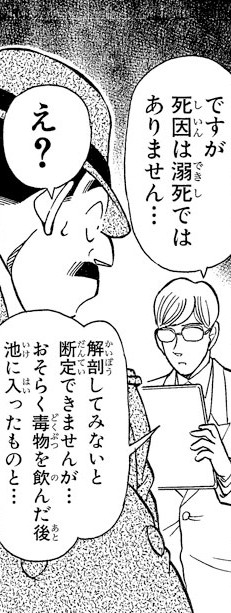
Inspector Megure suggests the murder suspect committed suicide by drowning himself. The medical examiner disagrees.
監察医( かんさつい ) :「ですが死因( しいん ) は溺死( できし ) ではありません…」
“However, drowning wasn't the cause of death...”
目暮( めぐれ ) :「え?」
“What?”
監察医( かんさつい ) :「解剖( かいぼう ) してみないと断定( だんてい ) 毒物( どくぶつ ) を飲( の ) んだあと池( いけ ) に入( はい ) ったものと…」
“I can't say for certain without an autopsy... but it's likely he took poison and then entered the pond...”
Challenge Yourself
Show translation
Challenge
What does the medical examiner suspect happened before the victim entered the pond?
Clues
おそらく毒物( どくぶつ ) を飲( の ) んだあと
probably after drinking poison
池( いけ ) に入( はい ) ったhe entered the pond
What does the speaker mean?
He drank poison.
The examiner tentatively places drinking 毒物( どくぶつ ) before entering the pond.
He drowned before taking any poison.
The examiner says drowning was not the cause of death and suspects poison first.
He performed an autopsy on someone else.
The examiner needs an autopsy performed on this victim to confirm the cause.
He was rescued from the pond alive.
The scene concerns determining the cause of the victim's death.
He accidentally drank pond water.
The suspected substance is 毒物( どくぶつ ) , poison.
He entered the pond before consuming anything.
あと places the pond entry after the suspected poisoning.
The examiner suspects that the victim drank poison and then entered the pond. An autopsy is still needed before that cause can be stated with certainty.
View Full Example
Planning
予定 (Schedule)予定( よてい ) means a schedule, plan, or arrangement. It refers to something decided in advance.
It combines 予 (in advance ) with 定 (decide ) to show something decided ahead of time .
ご注文はうさぎですか? »
Volume 1 » Page 67
Chiya and Syaro visit Cocoa at the coffee shop.
ココア:
「二人( ふたり ) ともこんな天気( てんき ) なのに遊( あそ ) びに来( き ) てくれてありがとね」
“Thanks, both of you, for coming to visit even in weather like this.”
シャロ:
「ちょうどバイトの予定( よてい ) 空白( くうはく ) になっただけだし」
“I just happened to have a gap in my work schedule.”
Challenge Yourself
Show translation
Challenge
What does ココア mean in the highlighted line?
Clues
遊( あそ ) びに来( き ) て(遊:あそ)びに(来:き)て means coming to visit
What does the speaker mean?
Thanks, both of you, for coming to visit even in weather like this.
The set expression uses "come to play" for a social visit, so "visit" fits the scene.
Cocoa thanks Syaro for coming only to work her scheduled shift.
The highlighted form is 遊( あそ ) びに来( き ) て. Here 遊( あそ ) びに来( き ) て means coming to visit, so this choice does not match the Japanese.
Cocoa asks Chiya and Syaro to leave because of the weather.
The highlighted form is 遊( あそ ) びに来( き ) て. Here 遊( あそ ) びに来( き ) て means coming to visit, so this choice does not match the Japanese.
Cocoa says they visited because the weather was especially good.
The highlighted form is 遊( あそ ) びに来( き ) て. Here 遊( あそ ) びに来( き ) て means coming to visit, so this choice does not match the Japanese.
遊( あそ ) びに来( き ) て means coming to visit. The set expression uses “come to play” for a social visit, so “visit” fits the scene.
View Full Example
Specification
特定 (Specification)特定( とくてい ) means identifying or singling out a particular person or thing.
It combines 特 (particular ) with 定 (fix ) to show fixing on one specific thing .
怪盗セイント・テール »
Volume 1 » Page 74
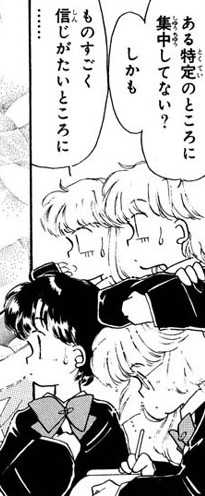
A student from a lower grade enters the classroom. She stops and stares at Asuka Jr., one of the boys in the class.
涼子( りょうこ ) :「ある特定( とくてい ) 集中( しゅうちゅう ) してない? しかも」
“Isn't she focused on one particular area? And on top of that...”
恭子( きょうこ ) :「ものすごく信( しん ) じがたいところに……」
“It's in a frightfully hard to believe area...”
Challenge Yourself
Show translation
Challenge
How does Kyoko describe the area that has the younger student's attention?
Clues
ある特定( とくてい ) のところに集中( しゅうちゅう ) してない?
Ryoko notices that the student's attention is fixed on one particular place
ものすごく信( しん ) じがたいところ
Kyoko finds that place extremely difficult to believe
What does the speaker mean?
It is an extremely surprising place for her to be focused on.
ものすごく intensifies 信じがたい, which describes the target of her attention as very hard to believe.
It is the only place where she can concentrate on studying.
集中 describes where the student is looking, while 信じがたい expresses Kyoko's disbelief about that target.
It is a familiar place that everyone expected her to notice.
信じがたい means difficult to believe, so Kyoko finds her focus unexpected rather than familiar.
It is too frightening for the students to look at directly.
The speakers express surprise, not fear or an inability to look there.
It is an area where the younger student is not paying attention.
Ryoko asks whether her attention is concentrated on a particular area, so the issue is where she is looking.
It is a place Kyoko has never been able to find.
信じがたい describes how unbelievable the target is, not whether Kyoko can locate it.
Ryoko notices the younger student’s attention gathering in one particular direction. Kyoko calls that target ものすごく信じがたい, showing that she finds the object of the stare extremely unexpected.
View Full Example
限定 (Limitation)限定( げんてい ) means limiting something to a particular scope, quantity, group, or condition.
It combines 限 (limit ) with 定 (fix ) to show something fixed within clear bounds .
Example 1 of 2: Limited edition with 限定 Example 1 of 2
俺物語!! »
Volume 6 » Page 103
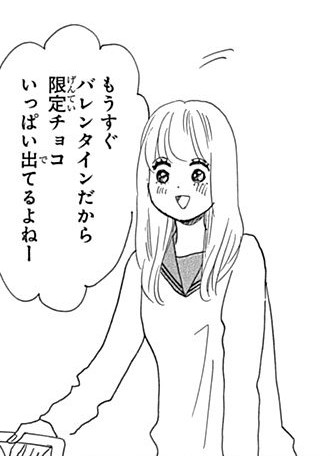
Takeo and Rinko meet up after school and stop somewhere for a drink and to chat. Rinko brings up February 14th, which is right around the corner.
凛子( りんこ ) :「もうすぐバレンタインだから限定( げんてい ) 出( で ) てるよねー」
“Since it's almost Valentine's, a lot of limited edition chocolates have come out.”
Challenge Yourself
Show translation
Challenge
What seasonal products does Rinko say are appearing?
Clues
もうすぐバレンタインだから
because Valentine's Day is coming soon
限定( げんてい ) チョコいっぱい出( で ) てるmany limited-edition chocolates are out
What does the speaker mean?
Many limited-edition chocolates for Valentine's Day.
限定( げんてい ) modifies チョコ, and いっぱい出( で ) てる says many have appeared.
A single permanent chocolate flavor.
いっぱい indicates many products, and 限定( げんてい ) makes them limited rather than permanent.
Limited tickets for a Valentine's event.
The noun after 限定( げんてい ) is チョコ, not tickets.
Chocolate that will disappear before Valentine's Day.
Rinko says the products are already out because the holiday is near. She does not give their removal date.
Discounted drinks sold only after school.
The line concerns seasonal chocolate and says nothing about drinks, discounts, or school hours.
Homemade chocolate that Rinko has finished making.
出( で ) てる describes products appearing on the market, not Rinko completing her own batch.
Rinko notes that many limited-edition chocolates have appeared because Valentine’s Day is close. The omitted が would mark the chocolates as the things that are out.
View Full Example
Example 2 of 2: Seasonal exclusive product with 限定 Example 2 of 2
からかい上手の高木さん »
Volume 3 » Page 136
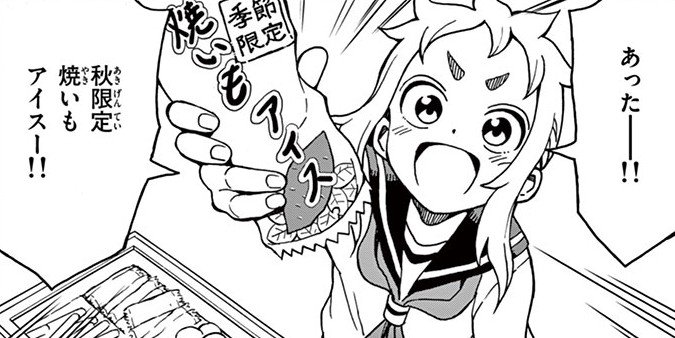
Mina stops by a local convenience store to buy a seasonal ice cream.
ミナ:
「あった!秋( あき ) 限定( げんてい ) 焼( や ) きいもアイスー!!」
“They have it! The autumn-exclusive baked sweet potato ice cream!”
Challenge Yourself
Show translation
Challenge
What is Mina excited to find?
Clues
あった!
an excited "There it is!" or "They have it!"
秋( あき ) 限定( げんてい ) "limited to autumn" or "available only in autumn"
焼( や ) きいもアイス"baked sweet potato ice cream"
What does the speaker mean?
Autumn-only baked sweet potato ice cream.
秋( あき ) 限定( げんてい ) modifies 焼( や ) きいもアイス, so the flavor is available only in autumn.
Baked sweet potatoes that are discounted for autumn.
限定( げんてい ) means limited or exclusive here, not discounted, and the product is ice cream.
Ice cream that has sold out for the season.
あった shows that Mina found it in stock.
A new ice cream shop that opens in autumn.
The noun is 焼( や ) きいもアイス, a flavor of ice cream, not a shop.
Sweet potato ice cream available all year.
秋( あき ) 限定( げんてい ) limits its availability to autumn.
An autumn gift made from baked sweet potatoes.
アイス identifies the item as ice cream, not a gift.
Mina’s あった shows that she has found the item she wanted. It is 秋( あき ) 限定( げんてい ) 焼( や ) きいもアイス, baked sweet potato ice cream sold only in autumn.
View Full Example
Stability
安定 (Stability)安定( あんてい ) means stability, with little risk of sudden change or disruption.
It combines 安 (peaceful ) with 定 (settled, fixed ) to show a peacefully settled state .
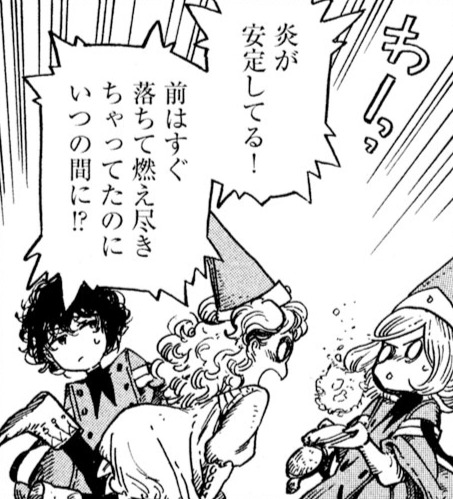
とんがり帽子のアトリエ »
Volume 2 » Page 50
Coco and her friends are trapped in a maze and trying to find a way past a dragon. Seeing the others working out magic to use, Coco tries her hand at a spell, creating a flame. Agott isn’t impressed, but Tetia feels otherwise.
テティア:
「炎( ほのお ) が安定( あんてい )
“The flame is stable!”
「前( まえ ) はすぐ落( お ) ちて燃( も ) え尽( つ ) きちゃってたのにいつの間( ま ) に!?」
“It used to go out and burn out right away, so when did this happen!?”
Challenge Yourself
Show translation
Challenge
Why is Tetia surprised by Coco's flame?
Clues
炎( ほのお ) が安定( あんてい ) してる!the flame is burning steadily now
前( まえ ) はすぐ落( お ) ちて燃( も ) え尽( つ ) きちゃってたのにcontrasts the current flame with earlier attempts that quickly fell and burned out
What does the speaker mean?
The flame is stable now, although Coco's earlier flames quickly burned out.
安定( あんてい ) してる describes the flame now, while 前( まえ ) は and のに contrast it with Coco's failed attempts before.
The flame used to be stable, but it has suddenly started burning out.
This reverses the timeline. 前( まえ ) は introduces the flames that burned out, and the current flame is stable.
The flame fell before Coco could make it burn steadily.
Falling and burning out describe Coco's earlier attempts. Tetia says the flame she sees now is stable.
Coco made the flame disappear as soon as Tetia noticed it.
すぐ belongs to the description of earlier flames. The current flame remains steady.
Tetia realizes that Agott created the stable flame instead of Coco.
The lines compare the current flame with Coco's previous results. They do not identify Agott as its creator.
Tetia wonders when the group moved away from the dragon.
いつの間( ま ) に asks when Coco's improvement happened, not when the group changed location.
Tetia sees that Coco’s flame is stable. That is a clear improvement because Coco’s earlier flames would fall and burn themselves out right away, so Tetia blurts out いつの間( ま ) に to ask when Coco became able to do this.
View Full Example