Craftman's efforts making glassware with 職人
Vocabulary Explanation: Skilled artisan with 職人
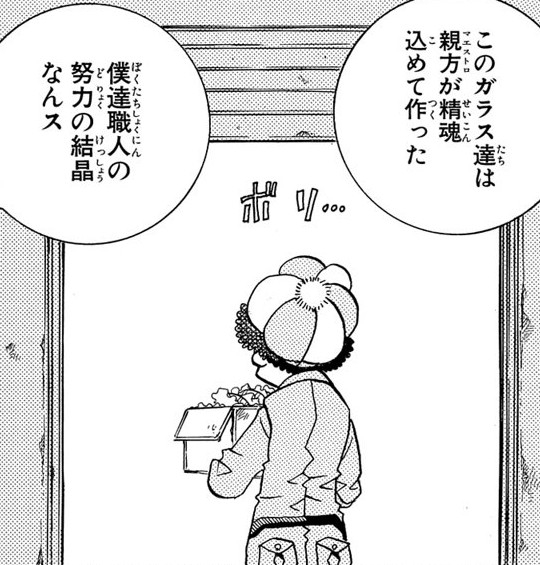
Akari picks up a box containing glassware items for her to transport. One of the employees from the shop making the glassware takes the box from her to place in her gondola. After he does this a second time, Akari says she can help carry the boxes, but he refuses.
- 職人:
- 「このガラス達は親方が精魂込めて作った」
- “These pieces of glass were made with the maestro's heart and soul poured into them.”
- 「僕達職人の努力の結晶なんス」
- “They're the crystallization of our craftsmen's efforts.”
結晶 can refer to crystallization, but also to the fruits (of one’s labor). He means the latter here, but the former works well in an English translation without losing the meaning.
Key Points
- In this scene, 職人 means trained artisans who carefully make the glassware, not just generic workers.
- It highlights skill, pride, and craftsmanship, which fits the speaker’s respect for how the pieces were made.
- There is no extra particle between 僕達 and 職人; the second noun identifies what kind of “we” he means.
- You can read 僕達職人の努力 as “the efforts of us craftsmen”.
- This kind of noun stacking is common in speech when the speaker is defining their group or role.
- Literally, 結晶 is a crystal or crystallization, but here it means the result that has taken shape from long effort.
- In context, he is saying these glass pieces are not ordinary products; they are the visible outcome of the artisans’ hard work.
- なんス is a colloquial contraction of なんです, common in casual masculine speech.
- It keeps the line friendly and conversational while still sounding earnest and emphatic.
Vocabulary
この (This)
この means “this” or “these” and comes directly before a noun. It points to something near the speaker or something the speaker is referring to in the conversation.
親方 (Master)
親方 means a master, boss, foreman, or senior craftsperson. The exact role depends on the trade.
精魂 (Heart and soul)
精魂 means one’s heart and soul or all of one’s spirit and energy. 精魂を込める means to pour one’s heart and soul into something.
作る (To make)
作る means to create or prepare something.
僕達 (We)
僕達 means “we” or “us” for a speaker who uses 僕 for “I”.
職人 (Craftsperson)
職人 means a skilled craftsperson or artisan trained in a manual trade.
努力 (Effort)
努力 means sustained effort or hard work toward a goal.
結晶 (Crystal)
結晶 means a crystal. Figuratively, it can be the product of sustained effort, as in “the crystallization of hard work”.
See Also
- Vocabulary: Skilled artisan with 職人
- Future entry: Past tense with 〜た・〜だ
- Grammar: Marking the subject with が
- Grammar: Marking the topic with は and も
- Kanji: Binding and results with 結
- Kanji: People and persons with 人
- Kanji: Reaching and attaining with 達