Reaching and attaining with 達
達 means reach or attain . In compounds, it also relates to delivery, communication, development, mastery, and groups of people.
Etymology
This kanji isa phono-semantic compound comprised of 辶 (movement along a road) as the semantic component and 羍 as the phonetic component (タツ).
People
人達 (People)人達( ひとたち ) means people or a group of people.
It combines 人 (person ) with 達 (plural group ) to show people as a group of persons .
名探偵コナン »
Volume 1 » Page 120
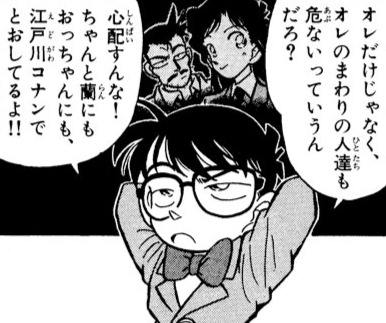
After Shin’ichi was forced to take a deadly drug that instead shrank him back to a child, he took on the undercover name Conan and went to stay with his childhood friend Ran and her detective father in the hope of a lead to the black-clad men who drugged him. He later discusses with Professor Agasa about how useless Detective Mouri is. The professor reminds Conan that the poison was supposed to have killed him, so he can’t rush and let others know his true identity.
コナン:
「オレだけじゃなく、オレのまわりの人達( ひとたち ) 危( あぶ ) ないっていうんだろ?」
“You're saying it won't be just me, but the people around me will be in danger too, right?”
「心配( しんぱい ) すんな!ちゃんと蘭( らん ) にもおっちゃんにも、江戸川( えどがわ ) コナンでとおしてるよ!!」
“Don't worry! I'm keeping up the Conan Edogawa act with Ran and the old man, too!!”
Challenge Yourself
Show translation
Challenge
Who does Conan say would be in danger if his situation became known?
Clues
オレだけじゃなく
not just me
オレのまわりの人達( ひとたち ) も危( あぶ ) ない
the people around me would be in danger too
What does the speaker mean?
Both Conan and the people around him.
だけじゃなく...も expands the danger from Conan to the people around him.
Only Conan himself.
だけじゃなく explicitly says the danger would not stop with Conan.
Only Ran and Kogoro.
Conan refers more broadly to the people around him, not only those two.
Only the men dressed in black.
The black-clad men are the threat. Conan is describing who could be harmed by them.
Nobody, because Conan has already revealed his identity.
Conan says he is still maintaining his cover identity with Ran and Kogoro.
Professor Agasa, but not Conan.
Conan includes himself first, then adds the people around him.
Conan understands Agasa’s warning to mean that exposing his identity would endanger more than Conan alone. The paired pattern だけじゃなく…も includes everyone around him as well.
View Full Example
私達 (We)私達( わたしたち ) means “we” or “us”, a group that includes the speaker.
It combines 私 (I ) with 達 (pluralizing suffix ) to show the group that includes me .
Example 1 of 2: Gotten completely lost in an abandoned building with 〜ちゃう Example 1 of 2
ARIA The MASTERPIECE »
Volume 1 » Page 138
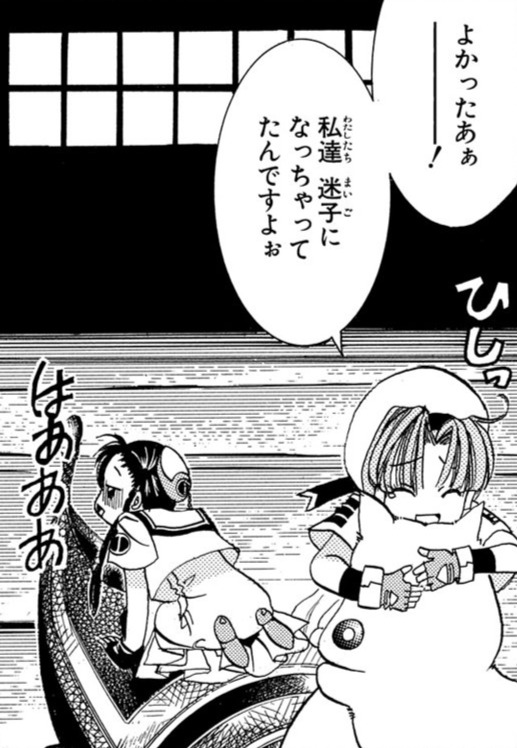
During training, Akari spots her company’s feline president, President Aria, sailing by in a small gondola. She instructs Aika to row the training gondola in the same direction, and the two follow him down an alley that’s normally gated from entry. The two lose sight of Aria and find themselves going in circles through flooded abandoned buildings. After some time, Aria’s gondola floats by.
灯里( あかり ) :「よかったあぁーーーーー! 私達( わたしたち ) 迷子( まいご ) になっちゃってたんですよぉ」
“Oh, thank goooodness! We had gotten completely lost, you know!”
View Full Example
Example 2 of 2: Wanting to go to with 〜たい Example 2 of 2
ご注文はうさぎですか? »
Volume 1 » Page 89
During a group study session, Cocoa turns the conversation to the high school options awaiting Chino.
ココア:
「チノちゃんは将来( しょうらい ) 私達( わたしたち ) 学校( がっこう ) とシャロちゃんの学校( がっこう ) 」
“Chino, in the future, between our school and Syaro's school...”
「どっち行( い ) きたい?」
“Which way do you want to go?”
Challenge Yourself
Show translation
Challenge
Which interpretation best matches the highlighted line?
Clues
行( い ) きたい(行:い)きたい asks which school Chino wants to attend
What does the speaker mean?
Which way do you want to go?
行( い ) く changes to the stem 行( い ) き before たい.
Cocoa asks which school Chino currently attends.
The highlighted form is 行( い ) きたい. Here 行( い ) きたい asks which school Chino wants to attend, so this choice does not match the Japanese.
Cocoa asks which school Chino has visited before.
The highlighted form is 行( い ) きたい. Here 行( い ) きたい asks which school Chino wants to attend, so this choice does not match the Japanese.
Cocoa is deciding which of the two schools she wants to attend.
The highlighted form is 行( い ) きたい. Here 行( い ) きたい asks which school Chino wants to attend, so this choice does not match the Japanese.
行( い ) きたい asks which school Chino wants to attend. 行( い ) く changes to the stem 行( い ) き before たい.
View Full Example
僕達 (We)僕達( ぼくたち ) means “we” or “us” for a speaker who uses 僕 for “I”.
It combines 僕 (I; humble male self ) with 達 (plural group ) to show people including me .
ARIA The MASTERPIECE »
Volume 4 » Page 226
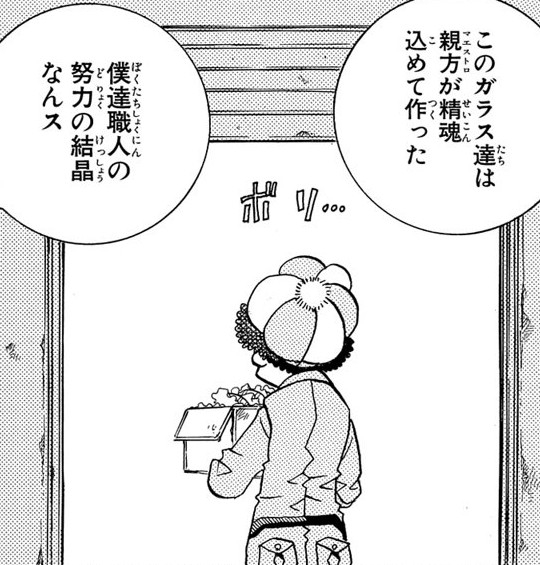
Akari picks up a box containing glassware items for her to transport. One of the employees from the shop making the glassware takes the box from her to place in her gondola. After he does this a second time, Akari says she can help carry the boxes, but he refuses.
職人( しょくにん ) :「このガラス達( たち ) は親方( マエストロ ) が精魂( せいこん ) 込( こ ) めて作( つく ) った」
“These pieces of glass were made with the maestro's heart and soul poured into them.”
「僕達( ぼくたち ) 職人( しょくにん ) の努力( どりょく ) の結晶( けっしょう ) なんス」
“They're the crystallization of our craftsmen's efforts.”
View Full Example
友達 (Friend)友達( ともだち ) means a friend or companion. Despite the suffix 達, it can refer to either one friend or several friends.
It combines 友 (friend ) with 達 (group ) to form the ordinary word for a friend .
Example 1 of 2: Don't know with わかんない Example 1 of 2
ひとりぼっちの○○生活 »
Volume 1 » Page 36
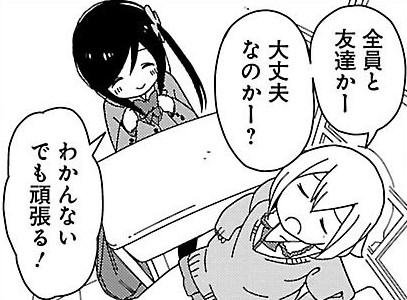
Nako learns of Bocchi’s necessity to become friends with everyone in class.
なこ:
「全員( ぜんいん ) と友達( ともだち )
“Friends with the whole class, huh?”
「大丈夫( だいじょうぶ ) なのかー?」
“Will you be okay...?”
ぼっち:
「わかんないでも頑張( がんば ) る!」
“I don't know, but I'll try my best!”
Challenge Yourself
Show translation
Challenge
How does Bocchi respond to Nako's concern?
Clues
わかんない
she does not know whether she will be okay
でも頑張( がんば ) る!
but she will do her best
What does the speaker mean?
She is unsure, but she will try her best.
わかんない admits uncertainty, while でも頑張( がんば ) る shows that Bocchi intends to try anyway.
She knows she cannot do it, so she gives up.
Bocchi does not claim certain failure. She says she does not know, then commits to doing her best.
She is certain that making friends will be easy.
わかんない expresses uncertainty, not confidence about the outcome.
She asks Nako to make friends with everyone for her.
頑張( がんば ) る describes Bocchi's own decision to try. She does not pass the task to Nako.
She plans to wait until she knows she will succeed.
でも connects her uncertainty directly to action. Bocchi will try despite not knowing the result.
She says Nako should not worry about the class.
The response concerns Bocchi's uncertainty and effort. It does not tell Nako how to feel.
Bocchi cannot say whether she will be okay, but that does not stop her. でも contrasts わかんない with her firm decision to do her best and try to befriend everyone.
View Full Example
Example 2 of 2: Might get along with 〜かもしれない Example 2 of 2
ご注文はうさぎですか? »
Volume 1 » Page 24
Tippy remarks on how Cocoa adapted immediately to working in the café.
お父( とう ) さん:
「ただあの娘( こ ) あっという間( ま ) に店( みせ ) になじんでしまった」
“Still, that girl settled into the café in no time.”
ティッピー:
「チノにはああいう友達( ともだち ) 合( あ ) ってるかもしれん」
“Maybe a friend like that suits Chino.”
Challenge Yourself
Show translation
Challenge
What does ティッピー mean in the highlighted line?
Clues
かもしれん
かもしれん is a contracted form of かもしれない
What does the speaker mean?
Maybe a friend like that suits Chino.
Tippy uses the shorter かもしれん to say that a friend like Cocoa may suit Chino.
Tippy says a friend like Cocoa definitely does not suit Chino.
The highlighted form is かもしれん. Here かもしれん is a contracted form of かもしれない, so this choice does not match the Japanese.
Tippy says that he, rather than Cocoa, should be Chino's friend.
The highlighted form is かもしれん. Here かもしれん is a contracted form of かもしれない, so this choice does not match the Japanese.
Tippy says Cocoa has failed to settle into the café.
The highlighted form is かもしれん. Here かもしれん is a contracted form of かもしれない, so this choice does not match the Japanese.
かもしれん is a contracted form of かもしれない. Tippy uses the shorter かもしれん to say that a friend like Cocoa may suit Chino.
View Full Example
Supply
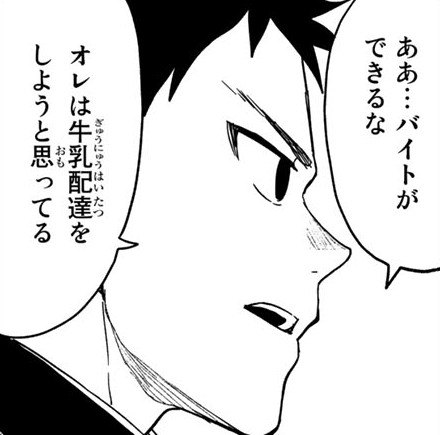
配達 (Delivery)配達( はいたつ ) means the delivery of letters, packages, meals, or other items to a recipient or destination.
It combines 配 (distribute ) with 達 (reach ) to show distribution that reaches the recipient .
それでも歩は寄せてくる »
Volume 6 » Page 4
Takeru and Ayumu talk about now being in high school.
歩( あゆむ ) :「ああ…バイトができるな」
“Yeah, I can get a part-time job.”
「オレは牛乳( ぎゅうにゅう ) 配達( はいたつ )
“I'm thinking of doing milk delivery.”
Challenge Yourself
Show translation
Challenge
What part-time job is Ayumu considering?
Clues
バイトができるな
"Now I can get a part-time job."
オレは牛乳( ぎゅうにゅう ) 配達( はいたつ ) をしようと思( おも ) ってる
"I am thinking of doing milk delivery."
What does the speaker mean?
Delivering milk.
牛乳( ぎゅうにゅう ) 配達( はいたつ ) names milk delivery, and しようと思( おも ) ってる marks it as Ayumu's current plan.
Working at a shogi shop.
Ayumu discusses part-time work, but the job he names is milk delivery.
Studying instead of taking a job.
バイトができるな shows that he is pleased he can now work part time.
Delivering newspapers with Takeru.
The item being delivered is 牛乳( ぎゅうにゅう ) , milk, and Ayumu frames it as his own plan.
Helping at the school cafeteria.
No cafeteria appears in the line. The stated work is 牛乳( ぎゅうにゅう ) 配達( はいたつ ) .
Starting the job immediately that day.
しようと思( おも ) ってる describes an intention under consideration, not an immediate start.
Ayumu says he can now take a part-time job and follows with 牛乳( ぎゅうにゅう ) 配達( はいたつ ) をしようと思( おも ) ってる. He is thinking of delivering milk.
View Full Example